Diagrammatic Reasoning Practice Instructions
Overview
The Diagrammatic Reasoning Practice module helps you learn how to read and reason with visual systems turning arrows, symbols, and shapes into logical relationships. Each test includes 9 multiple-choice questions that get more challenging as you progress, automatically adapting to your accuracy. The test is untimed, letting you focus on understanding rather than speed, and your results appear instantly detailed, visual, and completely free.
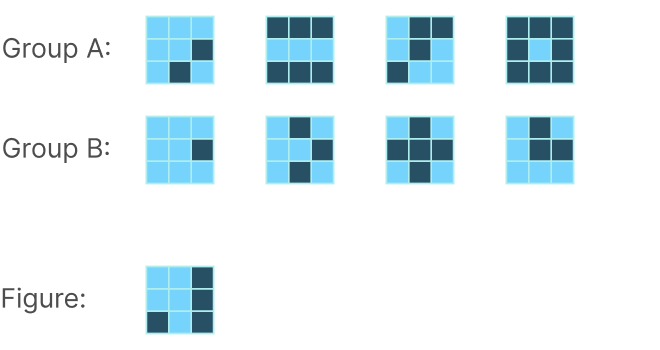
To which group does the figure belong?
Result & Explanation:
Your answer is CORRECT , the correct answer is A
Group A has only even numbers of dark gray cells, Group B has only uneven numbers of dark gray cells. The figure has 4 dark gray cells, therefore it belongs to Group A.
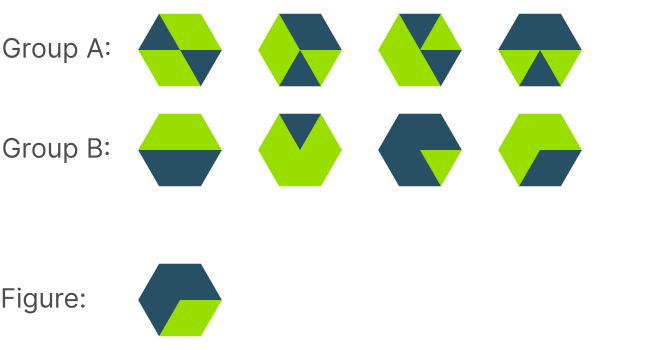
To which group does the figure belong?
Result & Explanation:
Your answer is CORRECT , the correct answer is B
Considering two or more triangles of the same color next to each other a group, then the objects in Group A have four sets of colored groups of triangles: two green and two dark gray triangles. Group B has only two groups of colored triangles, one green and one dark gray. The figure has two groups of triangles, therefore it belongs to Group B.
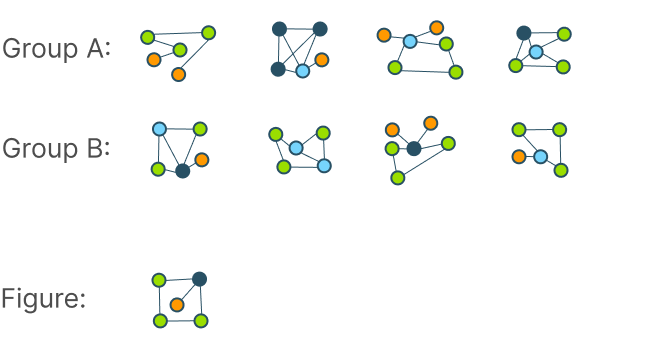
To which group does the figure belong?
Result & Explanation:
Your answer is CORRECT , the correct answer is A
The color of the dot is determined by the numbers of connections is has to other dots.
Group A: One connection: Orange. Two connections: Green. Three connections: Dark gray. Four connections: Blue.
Group B: One connection: Orange. Two connections: Green. Three connections: Blue. Four connections: Dark gray.
The figure has a dark gray dot with three connections, therefore it belongs to Group A.
Which operator replaces the question mark?
Result & Explanation:
Your answer is CORRECT , the correct answer is A
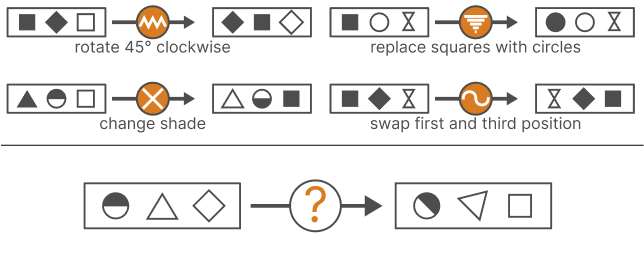
All objects after the operator are rotated 45 degrees clockwise. The first option is the right answer.
Which operator replaces the question mark?
Result & Explanation:
Your answer is CORRECT , the correct answer is D
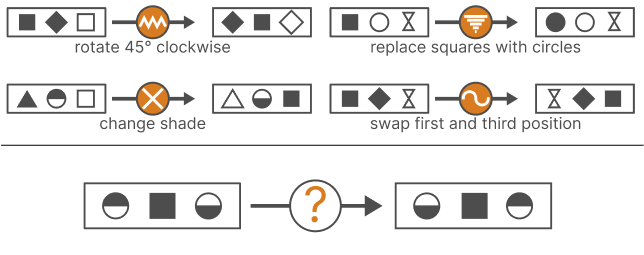
The first and third position of the objects after the operator are swapped, therefore the fourth option is the right answer.
Which operators replace the question marks?
Result & Explanation:
Your answer is CORRECT , the correct answer is B
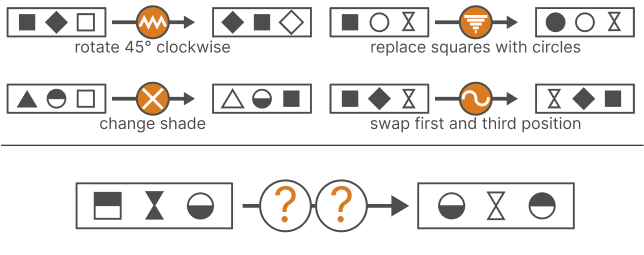
First the square is replaced with a circle. Then, the shade of all three objects is changed. Therefore, the second option is the right answer.
Which operators replace the question marks?
Result & Explanation:
Your answer is CORRECT , the correct answer is B
First, the first position is replaced with a circle. Then, the shade of the first and third position is swapped. Therefore, option two is the right answer.
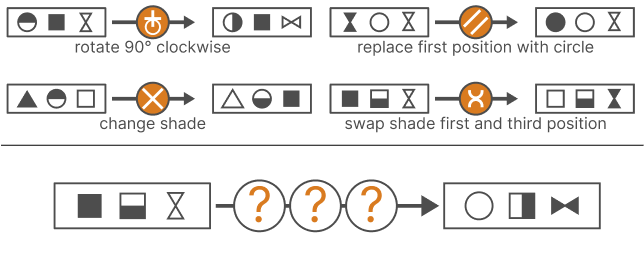
Which operators replace the question marks?
Result & Explanation:
Your answer is CORRECT , the correct answer is C
First, all objects are rotated 90 degrees clockwise. Then, the first position is replaced with a circle. Third, all objects change shade. Therefore, option three is the correct answer.
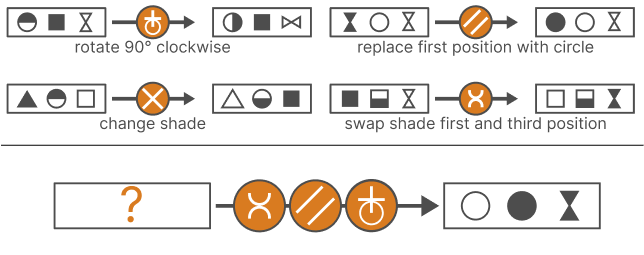
Which figures replace the question mark?
Result & Explanation:
Your answer is CORRECT , the correct answer is C
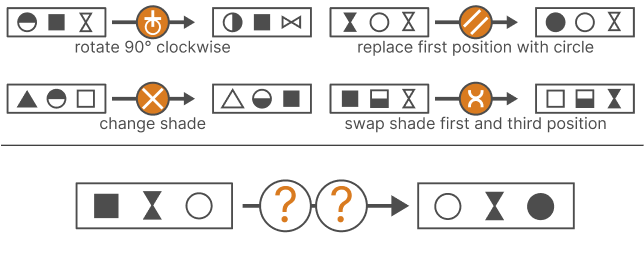
In this question you need to start with the last operator and work your way back to the starting point. So first rotate the figures 90 degrees counterclockwise. Then, replace the first position that became a circle with a new (unknown untill seen in the options) figure. Third, swap the shade of the first and third position. When correctly using the operators backwards, the correct answer is the third option.
Your Diagrammatic Reasoning Practice Results:
You answered 5 out of 15 questions correctly.
Full length IQ Test
Take our free IQ test and find out what your IQ is. Our IQ test is 100% free and provides instant results after completion.
Take the full IQ test
Test Format & Interaction
- Question styles:
- Input → Operator → Output transformations
- Flowchart continuation
- Rule-based shape progression
- Conditional branching logic
- Matrix-style operator grids
- Response format: Four diagram thumbnails (A–D); one correct continuation.
- Navigation: One diagram at a time; selection locks immediately.
- Adaptive engine: Starts with single-operator rules; advances to multi-step, nested, or conditional systems.
- Time guidance: Untimed—average completion: 9–14 minutes. External sketching encouraged.
Immediate Scoring & Feedback
Results shown in under 1 second:
- Total score (e.g., 8/9 | 89%).
- Rule-type heatmap (e.g., Transformation: 3/3, Branching: 2/3, Matrix: 3/3).
- Interactive walkthroughs:
- Animated replay of correct operator chain.
- Highlighted distractor flaws (e.g., “missing rotation + color swap”).
- Core diagrammatic principle (e.g., commutativity, associativity of operators).
Retake Policy
- Unlimited attempts with procedurally generated diagrams.
- Optional free account logs rule-mastery trends (e.g., “Branching logic: +18% in 7 days”).
- Guest mode wipes all traces on exit.
Scoring Transparency & Psychometric Standards
- Scoring is strictly rule-based no ambiguity, no partial credit.
- Difficulty calibrated via two-parameter logistic IRT on 100,000+ responses.
- Diagnostic purpose only no normative ranking or certificate.
What Diagrammatic Reasoning Really Tests
Diagrammatic reasoning measures non-verbal logical architecture:
- Rule extraction from minimal examples.
- System simulation under transformation.
- Hypothesis testing against visual counterexamples.
It predicts performance in software engineering, process design, systems analysis, and abstract IQ matrices independent of language or math.
Question Archetypes (All Featured)
|
Archetype
|
Core Challenge
|
Sample Prompt
|
|
Linear Transformation
|
Single operator, consistent effect
|
“Apply △ to input → ?”
|
|
Parallel Streams
|
Multiple simultaneous rules
|
“Track A & B paths → final state”
|
|
Conditional Gates
|
If-then branching
|
“If red → rotate 90°; else mirror”
|
|
Operator Matrices
|
3×3 rule discovery
|
“Center cell = f(N, E, S)”
|
|
Recursive Loops
|
Feedback cycles
|
“Output feeds back as next input”
|
Why It Matters in the Real World
- Tech Hiring Gatekeeper: Used by Google, Amazon, McKinsey for systems-thinking roles.
- IQ Fluid Intelligence Proxy: Correlates r = 0.68 with Raven’s Advanced Progressive Matrices.
- Process Optimization: Faster BPMN/UML diagramming, bug-free logic flows.
- Cognitive Agility: Enhances mental model switching and error anticipation.
Evidence-Based Mastery Path
|
Stage
|
Focus
|
Daily Drill (8–10 min)
|
|
1. Rule Isolation
|
Single-operator mastery
|
3 linear questions → verbalize rule aloud
|
|
2. Multi-Rule Fusion
|
Parallel + conditional
|
3 mixed questions → sketch operator table
|
|
3. Matrix Decoding
|
3×3 discovery
|
1 full matrix → predict all 9 cells
|
|
4. Speed Layer
|
Sub-60 sec fluency
|
Impose 45-sec timer after 80% accuracy
|
|
5. Error Forensics
|
Distractor autopsy
|
For each miss: redraw correct path in color
|
Data Privacy & Ethical Design
- No PII for guests.
- Diagram hashes only; responses never stored raw.
- Aggregated data refines rule fairness (e.g., cultural neutrality).
- WCAG 2.1 AA: high-contrast mode, keyboard navigation.
Limitations & Complementary Training
- No verbal overlay (purely diagrammatic).
- No dynamic animation in core test (feedback only).
- Pair with full-length, proctored abstract series for high-stakes exams.
Ready to Decode the Matrix?
Start Free Diagrammatic Reasoning Practice (9 adaptive diagrams | Instant animated feedback | Infinite variants)