GLOBAL BRAIN INSTITUTE
IQ research . Assessment
Abstract:
The concept of “average IQ by age group” is often misunderstood as evidence that intelligence remains stable across the lifespan. In reality, IQ scores are age-normed, meaning the average score is statistically fixed at 100 within each age group. This article explains how age norming operates in modern IQ tests and why it can obscure real differences in cognitive performance between age groups. Drawing on longitudinal and test standardization data, the article distinguishes age-adjusted IQ scores from raw cognitive performance and outlines well-documented lifespan patterns, including early adulthood peaks and age-related cognitive decline.
The phrase average IQ by age group is frequently misunderstood in public discussions about intelligence. Many people assume it reflects a stable level of cognitive ability across the lifespan. In reality, IQ scores are explicitly designed to be age-relative, not age-neutral.
An IQ score does not represent absolute intelligence. Instead, it indicates how an individual performs on cognitive tasks compared to others of the same age. As a result, a score of 100 reflects average performance within an age group, not identical cognitive capacity across different ages.

Average IQ scores are standardized by age groups
IQ, or Intelligence Quotient, was introduced by psychologist William Stern in 1912, building on Alfred Binet’s earlier work in educational assessment. Modern definitions emphasize relative performance. Mensa International defines IQ as a score indicating how well a person performs on mental tests compared to age peers, rather than a fixed measure of intelligence (Mensa International, n.d.).
A 20-year-old and a 75-year-old can both score 100 on an IQ test. This does not mean they possess the same processing speed, memory capacity, or problem-solving efficiency. It means each performed at the average level for their respective age group.
Early IQ tests calculated scores using a ratio formula:
Mental Age ÷ Chronological Age × 100
This approach worked reasonably well for children but failed for adults, where mental age does not increase linearly with chronological age. As a result, modern IQ testing abandoned the ratio method.
Modern tests such as the Wechsler Adult Intelligence Scale (WAIS) use statistical standardization. Raw test scores are converted so that each age group has:
This process, known as age norming, is performed separately for each age cohort (Wechsler, 2008). Age norming allows fair comparison within age groups but prevents direct comparison of cognitive performance between age groups.
Key takeaway: IQ scores are relative, not absolute.
The Role of Statistical Standardization
The reason average IQ by age group always appears to be 100 is simple: it is built into the test design. IQ tests are periodically recalibrated so that the mean score for each age group remains 100. This statistical feature ensures that individuals are evaluated relative to their peers. However, it also means that IQ scores conceal age-related cognitive change.
What Age-Adjusted Averages Hide About Cognitive Change
Because the average is reset at each age, declines in processing speed or improvements in accumulated knowledge are not visible when looking only at standard IQ scores. The statement “average IQ is 100 at every age” is technically correct but cognitively misleading.
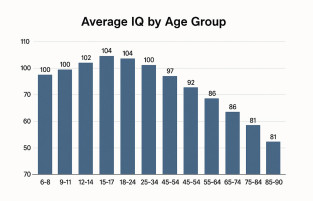
To explore what age-adjusted IQ scores conceal, researchers have examined raw cognitive performance, that is, how different age groups perform when compared to a common reference point, typically peak young adulthood.
Drawing on longitudinal studies such as the Seattle Longitudinal Study and WAIS standardization data, researchers have estimated how cognitive abilities change when age adjustments are removed.
|
Age Group |
Overall Cognitive Performance |
Fluid Intelligence |
Crystallized Intelligence |
Processing Speed |
|
6–8 |
72 |
68 |
75 |
65 |
|
9–11 |
84 |
82 |
85 |
78 |
|
12–14 |
95 |
96 |
93 |
92 |
|
15–17 |
104 |
108 |
98 |
108 |
|
18–24 |
108 (Peak) |
112 |
103 |
115 |
|
25–34 |
106 |
108 |
105 |
110 |
|
35–44 |
104 |
102 |
108 |
102 |
|
45–54 |
101 |
96 |
110 |
95 |
|
55–64 |
97 |
89 |
109 |
85 |
|
65–74 |
92 |
82 |
105 |
75 |
|
75–84 |
86 |
75 |
98 |
68 |
|
85–90 |
81 |
70 |
92 |
62 |
Table: Estimated Raw Cognitive Performance by Age (IQ-Equivalent Scale)
The pattern is clear:
These trends align with findings from large-scale meta-analyses (Salthouse, 2010; Ritchie & Tucker-Drob, 2018).
Research from large longitudinal studies shows a clear pattern:
Fluid abilities decline with age
Crystallized abilities often improve
This pattern has been replicated across decades of research, including:
IQ scores are shaped by more than biology alone. Key influences include:
These influences underpin the Flynn Effect, the documented rise in average IQ scores across generations (Flynn, 1987).
Final Though
Average IQ scores by age group remain at 100 because they are designed to do so. This statistical feature allows fair comparison within age groups but masks the reality of cognitive aging. When age adjustments are removed, cognitive performance follows a clear lifespan pattern: early adulthood peaks, midlife stability in knowledge-based skills, and gradual decline in processing speed.
Understanding this distinction helps prevent misinterpretation of IQ scores and supports more informed discussions about intelligence, aging, and human potential.
References