GLOBAL BRAIN INSTITUTE
IQ research . Assessment
Abstracts
Why are there people who have been attracted to complex careers and others who have worked in the hands or service careers? Does intelligence, personality, opportunity, or a combination of the three cause career choice? Several decades of research in psychology and economics point to the fact that IQ actually has a significant impact on the sorting of careers that people undergo, which affects not only the kind of job they choose but also occupational status and earnings. Nonetheless, there is also contemporary evidence that intelligence is not only the determinant of career success. It depends on personality, motivation, social situation and performance measurement.
This paper discusses what the research really says about the connection of IQ and careers and how the popular interpretations take things a bit too far.
Population studies on a large scale always indicate that cognitive ability is firmly linked with occupational placement. The intelligence of the individuals is one of the strongest predictors of the occupations individuals choose, as a 2023 study of more than 40,000 individuals in a representative sample of the U.K. has affirmed that intelligence often outperforms age, parental background, and even education as predictors of the job people do.
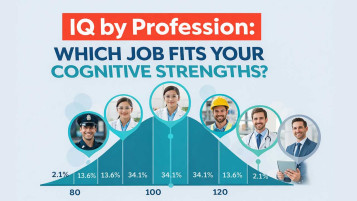
The high IQ scores were found in cognitively challenging occupations such as science, law, engineering, and financial management, and lower IQ scores concentrated on the manual, routine, and service-based jobs. The same trend is a result of job demands, but not personal value. More simply, higher-cognitive jobs require a more restricted and high level of cognitive ability and allow occupations that require less cognitive ability to utilize a broader range of ability.
A notable finding that has been ignored is that higher average IQ occupation also exhibits lower IQ variation. It is an asymmetry due to the fact that:
Although the IQ is a key factor in occupational sorting, it does not work in isolation. Research and associated studies by Wolfram reveal that non-cognitive traits play an important role in the career pathway especially in the occupational category.
Personality Traits (Big Five)
Different careers tend to attract different personality profiles:
Studies always show that IQ is positively associated with income and occupational prestige. Nevertheless, such relationships are not definite, but rather vague. IQ results in the probability to join higher-status occupations, and the results are not consistent as they depend on education, personality, and opportunities, not to mention life conditions.
The question whether IQ is a meaningful predictor of job performance, not only of job entry has been one of the most controversial aspects in psychology.
The supervisor ratings have been used to measure job performance in most studies. These ratings are:
Other meta-analyses have found moderate associations between job performance and IQ, which were obtained after using statistical correction measures to overcome measurement error, range restriction and sampling bias. But these corrections are based on assumptions that are commonly controversial.
Opponents claim that these adjusted correlations are theoretical highest limits and not the actual predictive confidence in the real-world. In a lot of first-hand research, raw correlations are unimposing and changeable.
IQ may influence job performance indirectly, by facilitating faster learning of job knowledge or easier adaptation to complex tasks. However, motivation, stress, confidence, and organizational support often play equally important roles.
A realistic framework looks like this:
In short: IQ opens doors; personality and context decide how far someone walks through them.
The fact that high IQ does not ensure career success and that average IQ does not mean that it cannot succeed.Career guidance must take a combination of cognitive strength, personality traits as well as personal values. Too much dependence on IQ as a metric of merit, it is likely to overlook other equally significant non-cognitive factors.
Conclusion
IQ plays a significant role in shaping career trajectories, especially in determining which occupational paths are realistically accessible. However, intelligence alone does not explain success, performance, or fulfillment at work.
Personality traits, delayed gratification, self-belief, and environmental conditions interact with cognitive ability in complex ways. Understanding these interactions allows for better career decisions and prevents the misuse of IQ as a simplistic or deterministic label. A nuanced view of IQ and career recognizes intelligence as an important ingredient, not the whole recipe.