GLOBAL BRAIN INSTITUTE
IQ research . Assessment
IQ tests are invaluable tools for assessing cognitive abilities and gaining profound insights into your intellectual strengths. Whether you're gearing up to take an IQ test or simply curious about the process, this FAQ guide will equip you with essential information on undertaking the test, developing your best performance, understanding the scoring methodology, and much more.
The Global Brain Institute (GBI) is an institution focused on researching the human brain and intellect. GBI's mission extends beyond understanding the brain; it also aims to apply its findings to enhance human life and potential. With a network of dedicated thinkers, researchers, and academics worldwide, GBI is at the forefront of brain research and its applications.
Yes, our IQ question bank is diverse, rigorous, and trustworthy. We have carefully curated questions that cover a wide range of cognitive abilities and skills to provide a comprehensive assessment. Our questions are developed and validated by experts in the field of psychology and psychometrics to ensure their accuracy and reliability.
Yes, our IQ questions undergo rigorous development processes with the guidance of experts in cognitive psychology and psychometrics. This ensures that they adhere to the latest scientific standards of validity and reliability. Our questions are carefully designed to measure a wide range of human cognitive abilities. It provides a comprehensive assessment of an individual's intellectual capabilities.
Gain insights into your cognitive strengths and areas for improvement with personalized feedback.
Our tests measure cognitive abilities in various areas. We utilize standardized scoring methods and advanced statistical analysis to ensure accurate results. We use the Item Response Theory (IRT) to determine the difficulty of each question and the ability of the test-taker based on their responses. Expected A Posteriori (EAP) is a statistical method used to estimate a person's ability level based on their responses to the test items. These methods help ensure that the test results are accurate and reliable.
Our IQ test takes 20 minutes to complete. However, the actual duration may vary slightly depending on the individual's pace and approach to the questions.
Our IQ test provides instant results upon completion. We offer a detailed report of your result, including your IQ score, your percentile of each cognitive aspect (numerical, logical, and spatial reasoning) for free.
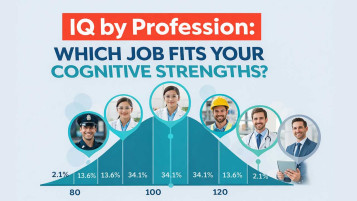
A good IQ score is often considered to fall within the range of 90 to 110. However, it's important to understand that IQ scores are relative, and what constitutes a "good" score can vary. The global population typically falls within an IQ range of 85–115, with a mean score of 100 and a standard deviation of 15. Here's a breakdown of IQ score ranges:
Yes, your cognitive ability in general and your IQ score in particular are definitely able to develop and improve over time. While your core intelligence might have certain limits, there are several ways to enhance your cognitive skills and perform better on IQ tests. Taking part in intellectual games, solving puzzles, playing strategy games, learning new skills or languages, practicing critical thinking, and continuous learning can contribute to your cognitive improvement. Moreover, maintaining a healthy lifestyle, regular exercise, a balanced diet, and a stress-free mind, can also positively impact your cognitive abilities.
Remember that IQ improvement takes a lot of time and consistent effort, so be patient and stay committed to your cognitive growth.
Yes, you should take the free online iQ test. Taking a free IQ test online can be an interesting way to engage your cognitive abilities and challenge yourself. Moreover, it’s totally free of charge.
Undertaking an IQ test is quite simple and straightforward on IQTestFree.IO:
Interpreting Your Score: Your IQ score will be provided along with a clear interpretation.
IQ tests do not have a pass or fail result. The purpose is to unveil one's cognitive abilities and compare them to others in a large population. The score is more of an assessment rather than a judgment of capability. IQ scores can provide insights into areas of strength and areas for development, making them a tool for understanding, rather than passing or failing.
Yes, you can retake the IQ test to try and improve your score or to see if your cognitive abilities have changed over time. However, it's advisable to have a considerable gap between the tests to ensure a more accurate measurement of any change in your cognitive skills. Our site offers you the opportunity to retake the test as many times as you want.
Yes, you can share your results on your favorite social account (Facebook, Twitter...). Our IQ test platforms provide easy sharing options for popular social networks. In fact, sharing is a way to celebrate your achievements or seek community admiration and support.
No, once the IQ test has commenced, it's designed to be completed in one session to ensure the integrity and accuracy of the results. The timed nature of the test is a crucial aspect of assessing your cognitive processing speed and other abilities. Therefore, pausing and resuming later would disrupt the standardized conditions under which the test is administered. If you're interrupted or need to stop during the test, it's typically necessary to restart the test at a later time.
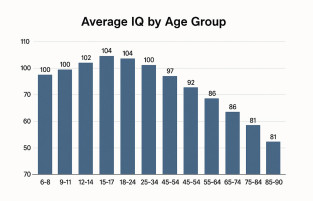
Yes, IQ tests can be taken by individuals of all ages. There are tests specifically designed for children, adolescents, and adults. Be sure to choose an appropriate test based on your age group.
There are three main tips to maximize your IQ score:
Honestly speaking, there is no trick to hack the high score on this test. IQ tests are designed to measure your inherent cognitive abilities rather than something that can be hacked or significantly improved upon in a short period. Remember, practice makes perfect, and attempting to “hack” the test would defeat this IQ test’s mission.
Mastering IQ test questions is a multifaceted skill that demands sharp observation skills, critical thinking, and mental agility.
IQ tests provide valuable insights into your cognitive abilities. By understanding the test process, scoring methodology, and available options, you can approach IQ tests with confidence and gain a deeper understanding of your intellectual strengths. Feel free to retake the test to track your progress and share your results with your social network to celebrate your achievements.